What to Write When You Don't Know What to Say
Write down one specific, true thing that happened, not a finished poem: a moment, a habit of theirs, a line you never said out loud.
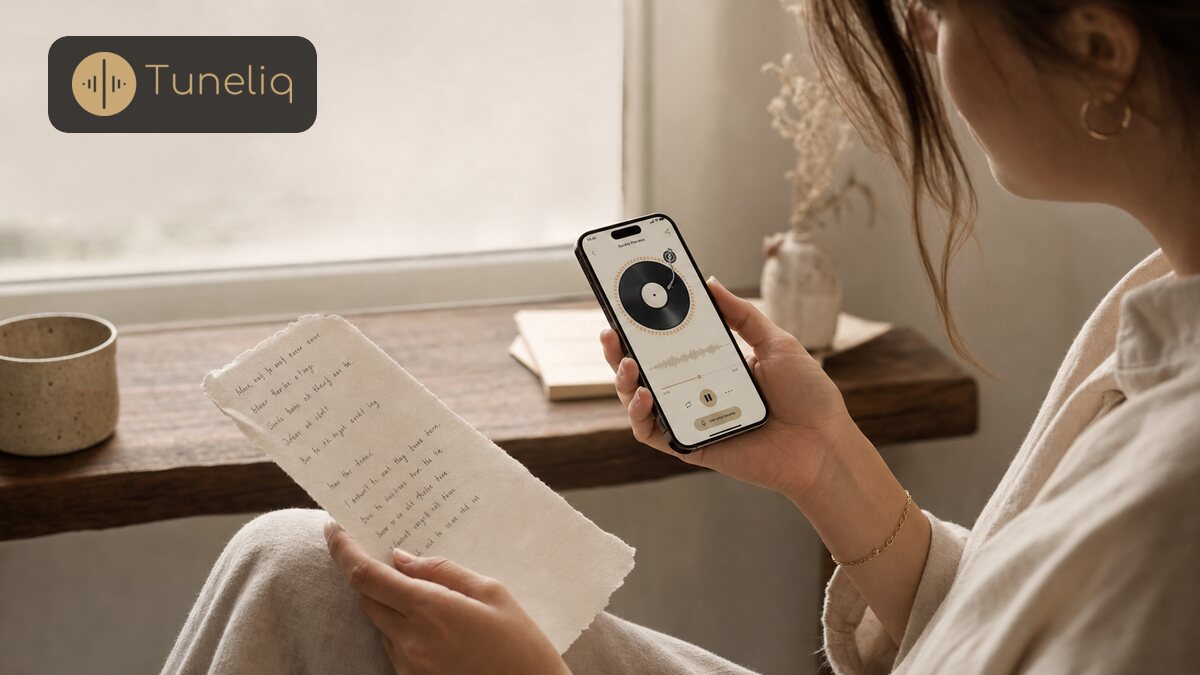
Write down one specific, true thing that happened, not a finished poem: a moment, a habit of theirs, a line you never said out loud. That one seed is enough, because Tuneliq drafts the full lyrics from it and you edit from there.
What if I don't have the perfect words?
You don't need them, and that's the point of how a personalized song gift works. Tuneliq drafts a full set of lyrics from whatever you hand it, so you're reacting to a draft instead of facing an empty page. Give it one plain, true sentence and the good lines come out of the editing, not out of you up front. Most people who freeze are trying to write the whole song at once. You only have to write the note. The full walk from that note to a finished song lives in How to Turn Something You Can't Say Into a Song; this piece is only about getting the first line out of your head.
What should I actually write down first?
Write one thing that actually happened, not a feeling. "You waited up for me every night that year" gives the app more to work with than "you mean so much to me." A feeling is true for a thousand people. A detail is true for one.
If you're staring at nothing, pick a starting point and finish the sentence out loud:
- A moment: "The day you..."
- A habit of theirs: "You always..."
- A thing you never said: "I never told you that..."
- A small detail only you'd notice: "The way you still..."
- A line of theirs you can hear: "You'd always say..."
Choose the relationship and the occasion before you write, like a partner's anniversary or your mom on Mother's Day. That one choice already points the song somewhere. Then answer a prompt honestly and specifically. For a proposal, reach for the ordinary Tuesday you already share instead of the big trip everyone posts about; the small shared thing is usually the one that lands. One good line is all you need to start, and you add the rest as you go.
What if the draft doesn't sound like me?
Then you change it. The first set of lyrics is a starting point you're meant to rewrite, not a verdict on your one sentence, and that's exactly why a single true line is enough to begin. If a line reads "through the years we've grown" and you'd never talk like that, swap in the real thing, like "since that apartment on Third Street." You keep going until it reads like you. How the editing actually works, line by line, is covered in the hub; here the only thing to know is that the draft is meant to be changed, so at the start your whole job is to hand over one honest line.
What if I'm still staring at a blank page?
Go listen to a few real ones first. The app's inspiration gallery has actual songs that started as somebody's plain words, sorted by occasion and relationship. There's a Mother's Day song called "Wrong Words" and a Father's Day one called "Windows Down." Hearing what a finished gift sounds like usually shakes a line loose. And if the person's first language isn't yours, that's fine; Tuneliq works in eight languages, so you can write to them in the one they grew up speaking.
The best way past a blank page is to write a single line to one person and watch what the app makes of it. Tuneliq is free on the App Store and Google Play.