What's Actually in a Song Gift: Words, Melody, Voice
A personalized song gift from Tuneliq has three parts: the words, the melody, and the voice that sings them.
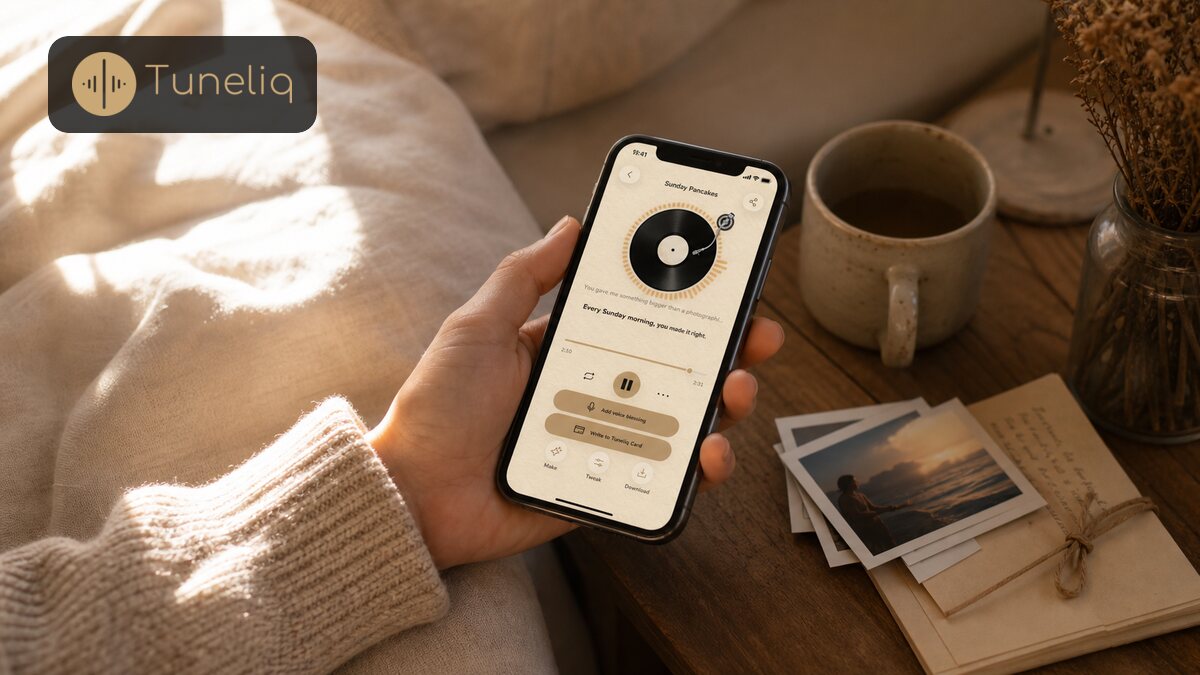
A personalized song gift from Tuneliq has three parts: the words, the melody, and the voice that sings them. You write the words, meaning what you want to say to someone, and edit the lyrics until they sound like you. Tuneliq composes the melody, the backing, and an AI-sung vocal. The "you" in the gift lives in the words.
What part do you actually write?
The words. Tuneliq is a personalized song gift, and it starts with you writing down what you want to say to someone. You pick the relationship and the occasion, then say the actual thing. Because staring at a blank page is the hard part, Tuneliq's AI drafts a full set of lyrics from what you wrote, so you have something to react to. Then you edit. Every line is yours to change, and you can hand the whole draft back with a note and let it rewrite from your feedback. You keep going until the lyrics read like something you'd actually say, not a greeting-card rhyme. That back-and-forth is the point. The finished lyrics are where your relationship shows up: the nickname, the bad joke, the thing you've never managed to say out loud.
Who writes the melody and plays the music?
Tuneliq does. Once the words are set, it composes a main melody and the backing music around them. You don't need to read music or play an instrument. This is the honest part: the AI is the band. You bring the words, it brings the musicians. AI music tools like Suno do something similar with the sound, and they're good at it — the real difference is what you walk away with. Suno hands you a track to make and remake. Tuneliq hands you one song, written for one person, in a form you can give.
Who's actually singing?
An AI voice sings it. Not you, and not a copy of anyone's real voice. When people hear "song gift," a lot of them picture singing into their phone themselves, or some stranger's voice reading their words back. Neither is what happens here. Tuneliq generates a sung vocal, synthesized for the song, that carries the lyrics you wrote and edited. So if you've been quietly worried you'd have to sing, or that the app clones someone's voice to do it, you don't and it doesn't. The vocal exists to deliver your words as a real performance, with phrasing and feeling, not to impersonate a particular person.
Can your own voice be in it at all?
Yes, if you want it there. Before the song starts, you can record a short spoken intro in your own voice, up to 60 seconds. That's the one spot where your literal voice lands in the gift: a hello, an "I made this for you," whatever you'd say if you were handing it over in person. It's optional. Skip it and the gift is your words set to a melody and a sung vocal. Add it and the person hears the real you first, then the song made from what you wrote.
So where's the "you" in the finished gift?
In the words, mostly, and in that spoken intro if you record one. Say the gift is for your mom. The AI writes the first draft and sings the final take; the melody isn't yours and the singing voice isn't yours. But the line about the phone call she never picked up, the plain way you finally said thank you — that came from you, reworked by you until it was right. A finished song usually runs two to three minutes, and it can be in any of eight languages, including hers. It's one-of-a-kind for a simple reason: it was written for her, and for nobody else.
If you want to see how those words turn into a finished song step by step, read how Tuneliq works.