Where is the "you" in an AI-made song?
The "you" is what the song is about. You write down what you'd say to someone, and the specific memories, the exact words, and the line-by-line edits are all yours.
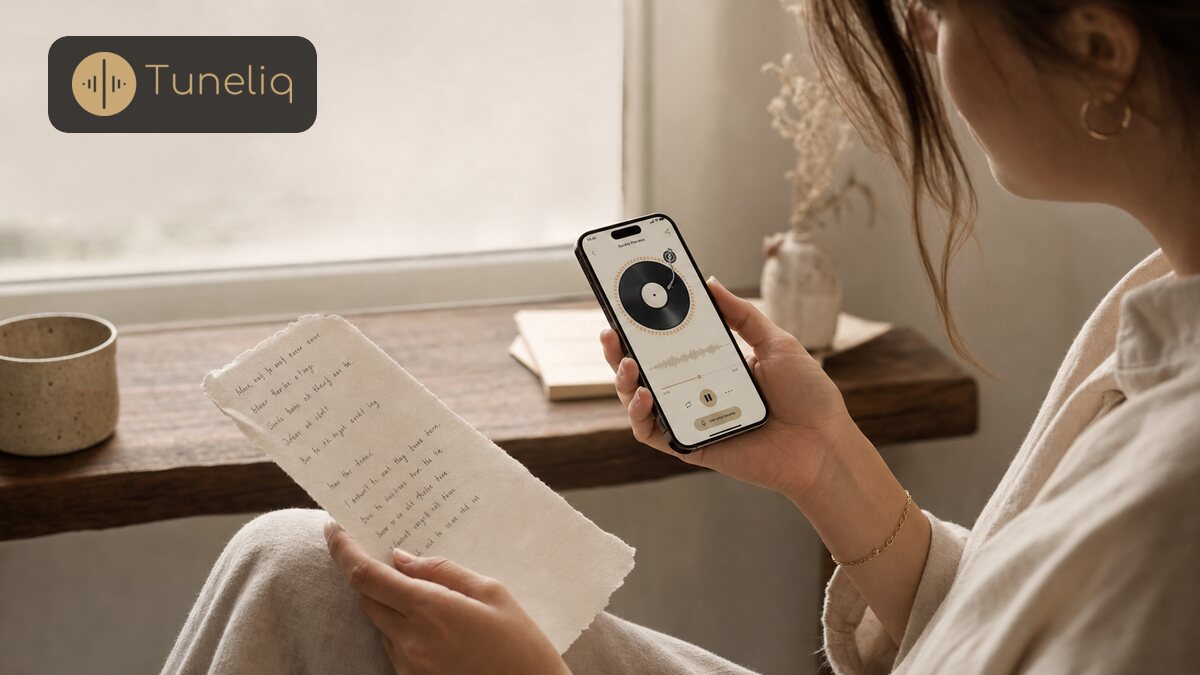
The "you" is what the song is about. You write down what you'd say to someone, and the specific memories, the exact words, and the line-by-line edits are all yours. Tuneliq is a personalized song gift, so the machine makes the sound and you make the meaning. This is about your side of that split; what the AI does and doesn't do is its own answer.
If a machine writes the song, is any of it really from you?
Yes, the part that matters is. An AI can rhyme on its own and carry a tune on its own. What it can't do is know that your grandmother used to call you by the wrong name on purpose, or that "drive safe" is the last thing your dad says every single time. It has nothing to say until you tell it what to say. Those things show up in the song only because you put them there, and they're the reason it could belong to one person and no one else.
What are you actually putting in?
Words, and specific ones. You type what you've been meaning to say and pick the relationship and occasion, and that's the raw material the whole song is built from. Here's the lever: the more exact you are, the more of you ends up in it. "I love you" could be anyone. The diner you always closed down, the voicemail she never deleted, the nickname only the two of you use, those could only be you. Specificity is the thing that turns a nice song into an unmistakably-yours one, and it's entirely in your hands.
Where does the "you" show up in the finished song?
In three places, and none of them is the melody. First, the words: the AI drafts lyrics from what you wrote, then you rewrite line by line until they read the way you actually talk. Second, the details you chose to keep, the ones no generic track would ever know. Third, if you want it, your own voice, a spoken intro up to sixty seconds that plays before the song starts, which is the one spot where the listener hears the real you.
That's three separate fingerprints on the same song, and you left all of them. The sung voice inside the song is AI-performed rather than yours; what the AI does and doesn't do with your words is worth its own read.
Doesn't the AI writing the draft dilute the "you"?
Not if you edit. A first draft always drifts toward the general, because it's guessing. The edit is where you pull it back to the true thing, cut the lines that could belong to anyone, and keep the ones that could only be about your person. You're not approving a machine's version of your feelings. You're using the draft to get faster to yours.
Next step
The easiest way to hear where the "you" lives is to play a few real ones. The app's inspiration gallery and the Gallery on tuneliq.com have example songs like the Mother's Day song "Wrong Words" and the anniversary song "Two A.M." — notice how each is carried by the writer's own words, not the music alone.