How do you edit the lyrics in a Tuneliq song until they sound like you?
Tuneliq is a personalized song gift. You write down what you want to say, and it drafts lyrics from your words.
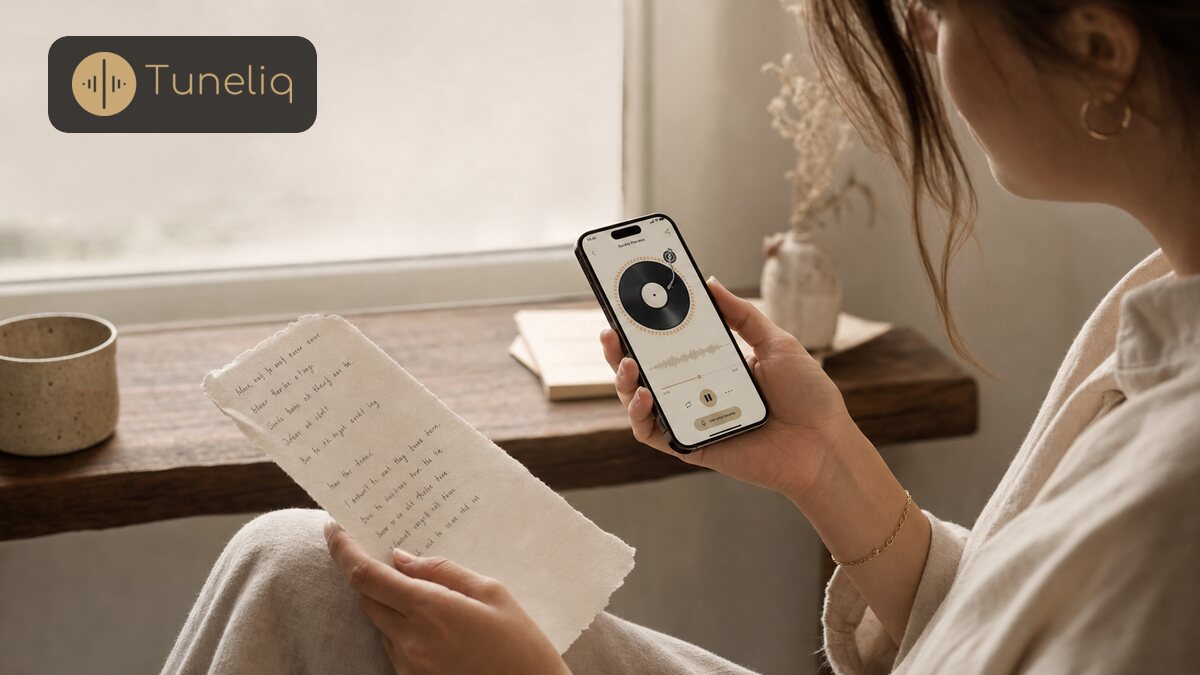
Tuneliq is a personalized song gift. You write down what you want to say, and it drafts lyrics from your words. From there you can change any line you want, or tell it what feels off and have it rewrite the whole thing. You keep editing until the words sound like something you'd actually say.
Why does the first draft come from the AI, not you?
You don't start with a blank page. You start by writing down what you want to say to someone: who they are to you, and the thing you've been meaning to tell them and can't quite get out. Tuneliq (TOON-leek) takes that and drafts a first set of lyrics.
That draft is a starting point, not the finished song. It's there so you have something real to react to. Most people find it easier to look at a line and think "no, not like that" than to write a whole verse from nothing. The AI gives you the rough shape. The rest is you.
Can you really change every line?
Yes. Every line is yours to edit. You can rewrite a single word or a whole line by hand, and it stays. Or you can step back, give a note about the song as a whole, and let the AI draft again.
Those notes can be plain and human. "This sounds too formal, she'd never talk like this." "Make the second verse about the summer we drove to the coast." "Less about me, more about her." The AI redrafts around what you said, and you go back and forth until it fits.
What does "sounds like you" actually mean?
It usually means trading a smooth line for a true one.
The AI might write something like "you've always been there for me." Fine, but anyone could say it. So you swap in the real thing: the nickname only the two of you use, the 2 a.m. phone calls during her first year away, the voicemail you still haven't deleted. A song stops sounding like a template the moment a detail shows up that only you two would recognize.
You don't need to be a writer to do this. You already know the specifics. Editing is mostly the work of putting them where the generic line used to be. If you want to hear how that lands before you start, the inspiration gallery in the app has real example songs you can listen to, like a Mother's Day one called "Wrong Words."
When do you stop editing?
When you read the lyrics back and they sound like your own voice, you're done. That's the whole test: does this sound like you talking to them?
Then Tuneliq composes it: melody, backing music, and a sung vocal. The voice is AI-sung, a synthesized singer, not your voice or anyone's real voice. A finished song runs about two to three minutes, and you can have the whole thing ready to give in a few minutes. It works in eight languages, so you can write in the words your person actually grew up hearing.
Isn't this the same as the AI music tools people already use?
Not quite, and the editing step is where they part ways. Tools like Suno or Udio are built to make you the creator of a track; you're producing music, and the more you know about music the further you can push it. Tuneliq isn't asking you to produce anything. The editing here has one job: getting your own words right, because the song is a gift meant for one person, not a track you're releasing.
That's why "does it sound like you" matters more than "is it polished." A polished song from a stranger's pen isn't the gift. The line she'll recognize as unmistakably yours is.
If you want to try rewriting a set of lyrics into your own words, Tuneliq is free to download on the App Store and Google Play.